


Anthony “Amp” Elmore and the Birth of the Made in Africa Movement
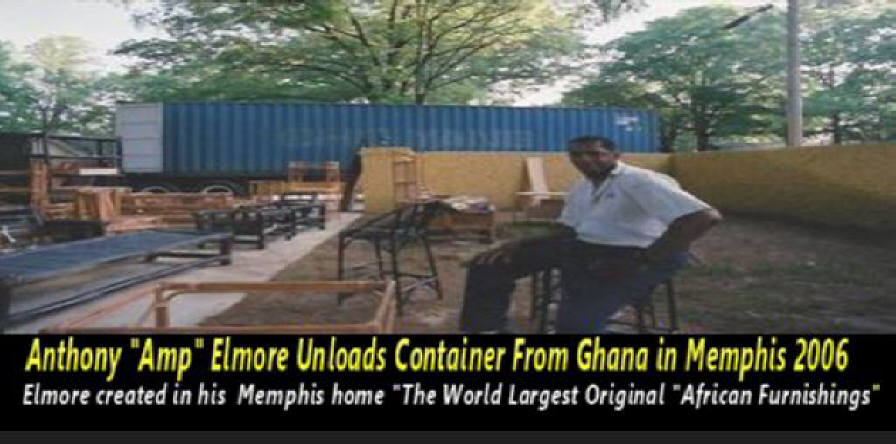
In November of 2005, Anthony “Amp” Elmore traveled to Accra, Ghana, with a vision that went far beyond tourism. He carried a camera, determination, and a dream: to create the most authentically African furnished home in America. The footage he captured during this trip is historic, documenting the painstaking process of designing and building furniture, doors, and carvings for his “All African furnish House” in Orange Mound, in Memphis.
Unlike simply importing ready-made goods, Elmore had to commission every item from scratch. Ghanaian artisans had never seen such a large order for African doors, and Elmore spent two months working side by side with them to bring his vision to life. This was not just about furnishing a home—it was about creating a living museum of African culture in America.
The Challenges of African Craftsmanship
The project revealed the immense challenges of adapting African craftsmanship to American standards:
Materials: When the doors were brought to America American carpenters nails counld not penetrate African hardwoods, and regular saw blades broke against the dense Idom wood used for the doors.
Finishing:** Ghanaian artisans lacked access to proper wood stains, resorting instead to using Kiwi shoe polish to color the doors.
Locks and Hardware: Elmore had to bring American locks, since Ghanaian locks were incompatible with U.S. standards.
Climate Adaptation: Outdoor furniture posed difficulties because the glue used in Ghana was water-based and brittle in cold weather, unsuitable for American climates.
These obstacles underscored the need for **education and training** to prepare African artisans to produce goods for the American market.
Cultural Authenticity
Beyond technical challenges, cultural differences also surfaced in design. When Elmore contracted Ghanaian carvers to create the doors, they initially carved White figures and European features, explaining that they thought this was what he would want. Elmore corrected them, insisting on authentic African imagery. He worked with the carvers to reshape the figures the best they could, ensuring that the doors reflected African identity and pride.
This moment was symbolic: it showed how deeply colonial influence had shaped perceptions of “value” in art, and how Elmore’s insistence on authenticity became part of his mission to reclaim African culture.
The completed home at 1035 Semmes Street in Orange Mound was more than a residence. It became a **living museum of African culture**, furnished entirely with custom-made African products. Every door, every piece of furniture, every carving told a story of resilience, creativity, and cultural diplomacy.
This house was the physical embodiment of Elmore’s vision: to integrate African culture into American life, not as decoration, but as identity.
From House to Tuxedo: The Obama Connection
In 2009, Memphis Congressman Steve Cohen delivered the tuxedo to President Obama. Today, it is preserved in the Barack Obama Presidential Library as a symbol of African cultural integration at the highest level of American history.
From the doors of his All African House to the tuxedo in the Obama Library, Elmore demonstrated that African culture could be woven into the fabric of American society.
The Father of African Cultural Diplomacy
Anthony “Amp” Elmore’s journey to Ghana in 2005 was not just about building a home—it was about building a movement. By working directly with artisans, solving technical challenges, and insisting on cultural authenticity, he laid the groundwork for what he calls the **Made in Africa Movement**.
This movement is about more than products. It is about:
Educating African designer and artisans** to meet international standards.
Creating infrastructurefor African imports to enter America.
Promoting cultural diplomacy through fashion, film, and furniture.
Reclaiming authenticity in how African products are represented.
The video from 2005 proves Elmore’s role as the Father of African Cultural Diplomacy, showing him on the ground in Africa, shaping history through culture and craftsmanship.
---
Legacy and Education
The story of Elmore African Imports is both educational and inspirational. It teaches that importing African products is not as simple as shipping goods—it requires cultural understanding, technical adaptation, and a commitment to authenticity. It shows that African artisans must be empowered with knowledge and resources to compete in global markets.
Most importantly, it demonstrates that African culture is not a commodity—it is a legacy. Through his All African House, his film *The Contemporary Gladiator*, and the Obama tuxedo, Anthony “Amp” Elmore has proven that African culture belongs in America, not as imitation, but as truth.
Elmore African Imports: From Accra to Orange Mound, from doors to tuxedos, from craftsmanship to diplomacy. The Made in Africa Movement lives on.